 ANTHEA: ALL THINGS ARE GODDESS

 The Temple of Persephone is almost done, but I wanted to get this out now in case someone can inspire me to make some changes in thought before it goes live.
 I'm trying desperately to make these musings as personal as possible since I think there is no one right way to interpret the Goddess. I hope you find something useful or thought provoking within my ramblings. (edits in bold)
M U S I N G S
Her story has resonated with millions of people over millennia and her archetype is firmly rooted in the human psyche. She is Persephone, Queen of the Underworld, transformation of the Sacred Bride.
While young Kore played in the fields, stopping to take in the scent of flowers, a hole opened up in the Earth below her. She was shaken as she stood gazing at the God Pluton in his chariot. He was beautiful to her eyes, a vision of perfect masculinity and a counterpart to her feminine grace. With a natural fear of things unknown, Kore allowed herself to be taken by Pluton and succumbed to her destiny as his lover and his queen.
Persephone entered my life quite some time ago. I had very little understanding of her mysteries at that time and simply thought of her as the Maiden in the most generic sense. As I studied her further she began to take on her full form in my heart, showing me that her story was timeless and poignant. She also showed me that her image was hardly limited to that of the Maiden. I felt as though she was calling me to rediscover her and find a way to fully integrate her into my personal image of the Great Goddess.
In Eleusis, where the mysteries thrived for so long, Persephone was revered as a primary deity, and as an integral symbol of the religious traditions of thousands. In this sacred space I invite you to soak in the story of Persephone and learn her lessons for yourself. Let her light embrace you and take you into the hallowed caves of Eleusis with all the wisdom of an initiate.
U N D E R S T A N D I N G
As with many triple Goddesses, it is impossible to talk about Persephone without taking into consideration her other aspects. My perception of the Goddess Persephone (Roman Proserpina) is that she is a distinct face of the Goddess, seperate from Kore, her Maiden aspect. I see Kore, Demeter, and Persephone as a complete Triple Goddess figure with Persephone filling the role of Crone.
Her name means "Destroyer". Through my studies I have found there are devotees of this Goddess who reject that notion on the grounds that her cycle is one of a blending of life and death without fear; that she is a queen of life and beauty and love. They believe that giving her the name Destroyer somehow strips her of the role of benevolent queen.
I propose that Persephone is indeed a destroyer. Her destruction is a necessary vehicle for transformation without which nothing new could ever be created. Much like Kali-Ma she is not only a destroyer of physical things (as she personifies death), but she is also a destroyer of fear, doubt, shame, and other negative things that are not conducive to spiritual growth. She is a remover of obstacles, again like Kali.
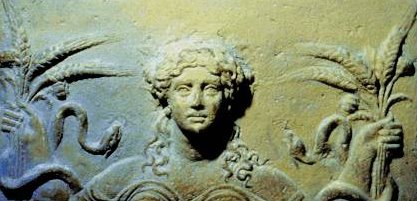
Many scholars and worshippers of Persephone also reject the idea of her rape by Pluton, also known as Hades. I would have to agree on this one for many reasons. As cited in Mysteries of Demeter: Rebirth of the Pagan Way by Jennifer Reif, the clergy of Persephone were all priestesses. It seems unlikely that women would have chosen to devote their lives to a religion that deifies the act of rape. I think instead Persephone's image was one of empowerment and equality, not of an abused woman without power of her own.
Also, as noted by Reif, there are images of Persephone and Pluton carved in stone that picture them sitting alongside each other on their thrones, equal and appearing to be the very essence of matrimonial partnership. Adding that to the fact that there is nothing that mentions rape in both the Orphic or Homeric texts, and it seems as though the idea of rape might have been a rather modern construct, perhaps introduced by mythology scholars or art historians. At some point someone was responsible for naming the first piece of ancient art or literature "The Rape of Persephone".
Persephone is the creation of Kore's experiences; she is a symbol of the transformation between child and adult. She bridges the gap between birth and death with Demeter standing at the center to impose the balance between the two and thus facilitating and perpetuating life.
A primary symbol of Persephone is the pomegranate. Eating its seeds symbolizes gaining wisdom and the knowledge of the mystery of eternal life. The pomegranate could quite possibly have been the first image of the fruit of knowledge spoken of in Jewish mythology. When I ponder this further though I find I come to a small conundrum. Jewish mythology (in the Old Testament of the Bible) says that the fruit was the downfall of humanity. I don't agree with this idea as I think knowledge is not a bad thing. I think perhaps though that ignorance truly is bliss and sometimes knowing too much causes suffering. It is easier and less painful to accept things blindly instead of pondering life for oneself.
So, the key words I have identified in regards to Persephone are destruction, wisdom, and partnership. (See the Temple of Merope for more on my keyword process.)
Destruction
- Destroying one thing transforms it into another. (death is not to be feared)
- Without destruction there can be no birth or growth.
- Destroying ego or negative qualities of the self is an important process in spiritual development.
Partnership
- The sexes are equal and compatible.
- Working together is a way to effect greater change. (cliche version: there is no "i" in team.)
- It is not good to bear the burden of life alone.
Wisdom
- Knowledge should be sought after.
- With wisdom comes a rebirth of the spirit.
- Don't waste your ability to learn and think for yourself.

Labels: demetrian paganism, eleusis, Goddess Discussion, Goddess Religion, Greek Goddesses, greek myth, homeric hymn to demeter, jennifer reif, kore, mysteries of demeter book, paganism, persephone





 In Her Image: Manufacturing the Dark Goddess


